The Crimson Star Chain Quilt Pattern combines red stars, small diamond centers, and taupe-and-white patchwork in a striking geometric design. Alternating blocks create diagonal chains across the quilt, while a narrow checker border repeats the smaller squares found around each star.
The white background gives the red points room to stand out. Taupe adds a softer middle tone, connecting the stars without competing with them. Together, these three colors create a coordinated design with plenty of detail to enjoy up close.
Below, you will find an overview of the project, fabric requirements, and assembly process. The free PDF at the end includes the cutting list, block diagrams, quilt layout, border instructions, and printable foundation templates.
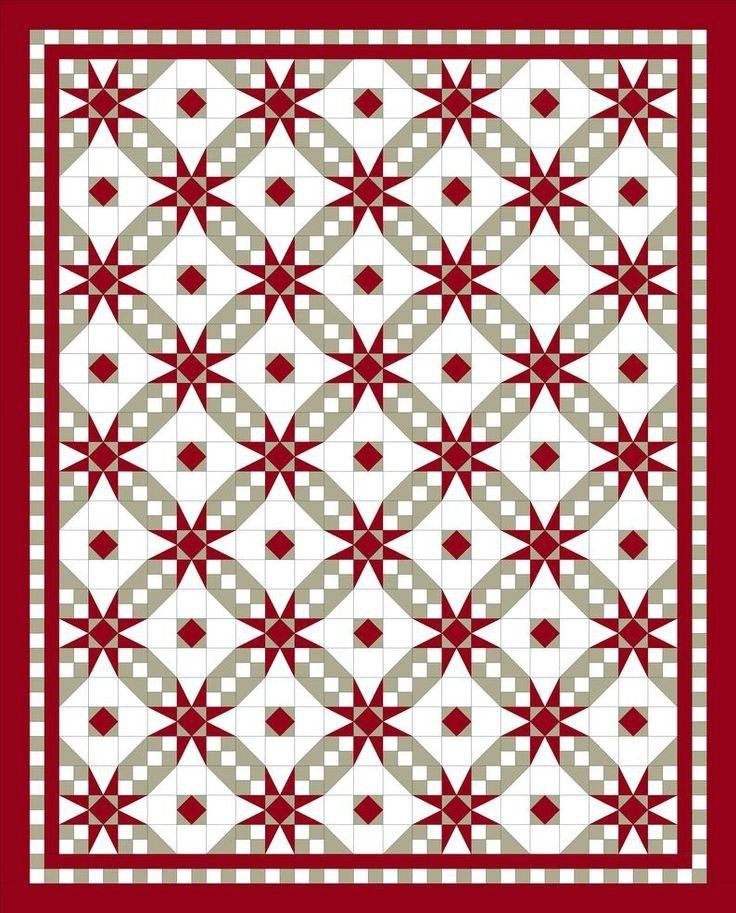
Before joining the rows, arrange the blocks on a design wall or a clean floor and view the quilt from a distance. This makes it easier to follow the diagonal chains and spot a four-patch or triangle facing the wrong direction. Take a clear photo of the arrangement, then label each row so you can carry the pieces to your sewing machine without losing their order.
Quilt Size and Skill Level
- Finished quilt: 75 × 93 inches, approximately 190.5 × 236.2 cm.
- Finished blocks: 9 × 9 inches.
- Layout: 7 blocks across and 9 blocks down.
- Block count: 32 star blocks and 31 diamond setting blocks.
- Skill level: Intermediate.
- Seam allowance: ¼ inch unless otherwise indicated.
This version was calculated from a reference diagram without original measurements. Its dimensions and piece counts have been checked mathematically, but it has not been test-sewn. Make one star block and one setting block before cutting the full project.
Materials Needed
Choose quilting cottons with clear differences between the light, medium, and dark fabrics. The PDF uses the following quantities:
| Material | Amount |
|---|---|
| Crimson red fabric | 5¼ yards, including binding |
| White or ivory fabric | 5 yards |
| Taupe or soft sage fabric | 3 yards |
| Backing fabric, 108 inches wide | 3 yards |
| Batting | At least 83 × 101 inches |
The top-fabric calculations assume 40 inches of usable fabric width. Large prints, directional motifs, or additional practice blocks may require extra fabric. You will also need a rotary cutter, cutting mat, inch rulers, pins, thread, an iron, and thin foundation paper.
In the instructions, WOF means width of fabric, HST means half-square triangle, and FPP means foundation paper piecing.
How the Two Blocks Work Together
The star block combines four-patch corners, elongated triangle units, and a red diamond center. Its narrow red points give the stars their distinctive shape. The PDF includes a foundation template for these units so their angles can be sewn along printed lines.
The setting block repeats the red diamond but surrounds it with white squares and taupe-and-white half-square triangles. Once the two block types alternate, their corners form the diagonal checker chains visible across the quilt.
Assembly Overview
- Prepare the small units. Follow the PDF cutting list to make the diamond centers, four-patches, star-point units, and half-square triangles. Keep each group labeled and check the unfinished measurements as you work.
- Piece the star points. Print the foundation sheet at 100% or Actual Size. Measure the test square before sewing. Each unit has a white center triangle and two red side pieces; ordinary half-square triangles will not reproduce these elongated angles.
- Build the blocks. Arrange each block as a nine-patch. In the star blocks, the white triangle points face the center diamond. In the setting blocks, the taupe triangles occupy the outer corners. Both block types should measure 9½ inches square before joining.
- Arrange the quilt center. Alternate the 32 star blocks and 31 setting blocks in nine rows of seven. Place a star block at each corner of the quilt center. Check the full layout before sewing the rows together.
- Add the borders. Attach the narrow red border, followed by the checker border and the wider outer red border. The PDF shows the starting and ending colors for each checker strip so the alternating sequence continues around the corners.
- Quilt and bind. Remove the foundation papers, prepare the backing and batting, and baste the layers. Quilt as desired, then finish with the red binding. Allow for some size change during quilting and washing.
Choosing Fabrics for Your Version
Small florals, subtle textures, and solids can all suit this layout. Keep the background light enough that the star points remain easy to see. If you use a patterned taupe fabric, choose a print that still reads as a medium tone from a distance.
For another color scheme, try navy stars with a pale gray chain, or deep green stars with a warm cream background. Keeping the same light, medium, and dark relationships helps preserve the design when you change the palette.
Download the Free Crimson Star Chain Quilt Pattern
The Crimson Star Chain Quilt Pattern brings its detail together through two repeating blocks and a coordinated border. Work through one unit at a time, check the rotations, and use the diagrams to keep the chains aligned.
The free 15-page PDF includes fabric requirements, cutting measurements, illustrated unit instructions, block layouts, border calculations, and a full-size foundation sheet.
Crimson Star Chain Quilt Pattern
The white areas of the Crimson Star Chain Quilt offer space to explore different quilting textures. Gentle curves could soften the angular patchwork, while straight lines could emphasize its geometric structure. Try your chosen quilting design on a small sandwich made from leftover fabric and batting first. This gives you a chance to compare thread colors and see how the stitching looks against both light and dark fabrics.
The backing is another opportunity to make the quilt feel personal. A small floral print containing touches of crimson and sage would connect the front and back, while a simple tonal fabric would let the quilting stitches take more attention. Finish with a label showing the completion date and, if the quilt is a gift, a short message for its recipient.