Look at the center of the Taos Quilt and you’ll see a turquoise star. Follow one of its points outward and a second shape comes into view. Strips of rust, ochre, and sand turn together like a folded ribbon, with little charcoal diamonds tucked into the bends. Those dark accents are worth a close look if you’re choosing fabrics from your stash. A few small scraps do much of the work of giving this quilt its depth.
This Quilt Missouri version finishes at 50 × 50 inches (127 × 127 cm). Adapted from a reference photograph, it uses raw-edge appliqué for the stars and diamonds and straight seams for the narrow frames. The printable pattern includes a placement diagram you can assemble at home and reuse for all four quarters of the medallion.
Start with the warm fabrics. Lay a strip each of rust, ochre, and sand on an ivory background, then tuck a small piece of charcoal beside the ochre. Step back a few feet. Can you still see where the ribbon changes direction? If the sand disappears into the ivory, try a slightly deeper tan. If the charcoal draws your eye before anything else, try a softer brown-black.
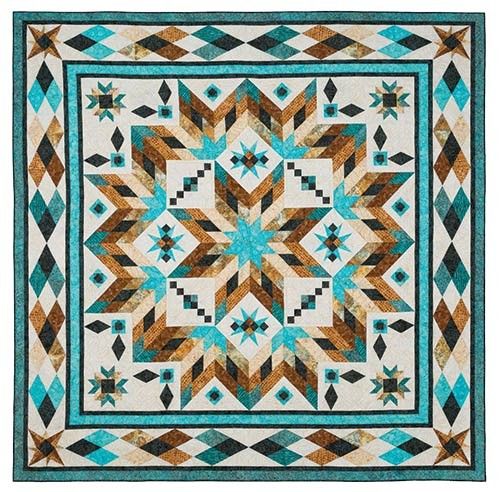
For the cool colors, save your brightest turquoise for the center star and repeat it in the outer diamonds. A deeper teal works well along the edge, where it gives the ivory border a crisp outline. Small-scale batiks are a good choice for the narrow points. To see how a favorite print will look when cut, lay its paper template on top and fold the fabric back until only a point-sized patch shows.
Building the medallion one quarter at a time
The most helpful marks in this project are the two center creases in the ivory foundation. They show you exactly where to turn the placement master. Print pages 7–15 at 100% or Actual Size. Before taping the sheets together, measure the one-inch check square in both directions. The nine sheets form one 18-inch-square quadrant.
Keep the assembled master face up when marking placement on the background. Turn it face down when tracing onto the paper side of your fusible web. That small change matters at the bends in the ribbon. Lay the first few fabric shapes on their marked positions with the paper still attached and check which way the bend points before pressing.
Keeping the diamond border in order
Each side has five repeats. On the top border, the turquoise end units lead into warm ochre units, with deep teal at the midpoint. The two units to the right of center mirror the two on the left. Lay out one whole side before fusing, then take a quick photo. When you turn the next strip to work on it, the photo makes it easy to check which points face the outside edge.
The little corner stars are a handy place to practice your edge stitching. Try one point on spare ivory cotton with the same fusible web and thread you plan to use. A narrow zigzag should catch the background on one swing and the appliqué on the other. At the tip, stop with the needle down, lift the presser foot, and pivot. Check that the fabric lies flat before stitching the remaining stars.
The smallest stars make lovely places to tuck in a favorite scrap. If you have a turquoise batik left over from another quilt, try it in the points of one corner star. Cut a little window in a piece of paper the size of a single point and slide it across the fabric. A shift of half an inch can bring a pale streak into view or give you a deeper blue tip against the ivory.
Before fusing the medallion, look closely at the center where the four quarters meet. Lay a ruler along each crease and check that opposite turquoise points line up across the star. Then lift the ruler and look at the little wedges of ivory between the points. If one wedge looks narrower than its partner, a small adjustment now will bring the center back into balance.
Download the free Taos Quilt Pattern PDF
The charcoal squares need a different kind of attention. They form short diagonal chains, and one tilted square can make a chain look crooked even when its two ends are in the right place. Lay a clear ruler gently over the loose pieces and sight along their centers. Once they line up, lift the ruler straight up so the smallest squares stay where you placed them.
After quilting, lay two folded strips of binding along one finished corner before choosing your fabric. Deep teal carries the color of the outer frame all the way to the edge. Charcoal picks up the dark centers of the corner stars and gives the quilt a fine outline. Fold each strip to the width that will actually show on the front; a narrow sliver of charcoal looks quite different from a full strip laid flat.
The 17-page guide includes fabric amounts, cutting measurements, a color layout, full-size appliqué templates, and instructions for the borders, quilting, and binding. The templates were drafted from the photograph, and this adaptation has yet to be test-sewn. A scrap sample of the smallest star is a good first step before cutting your chosen batiks.
Download the free Taos Quilt Pattern PDF
For the quilting itself, try outlining the long copper-colored bends in a matching thread and adding a second line in the ivory beside them. Up close, that line gives the background texture. From across the room, the turquoise star and the folded ribbons still catch the eye first.