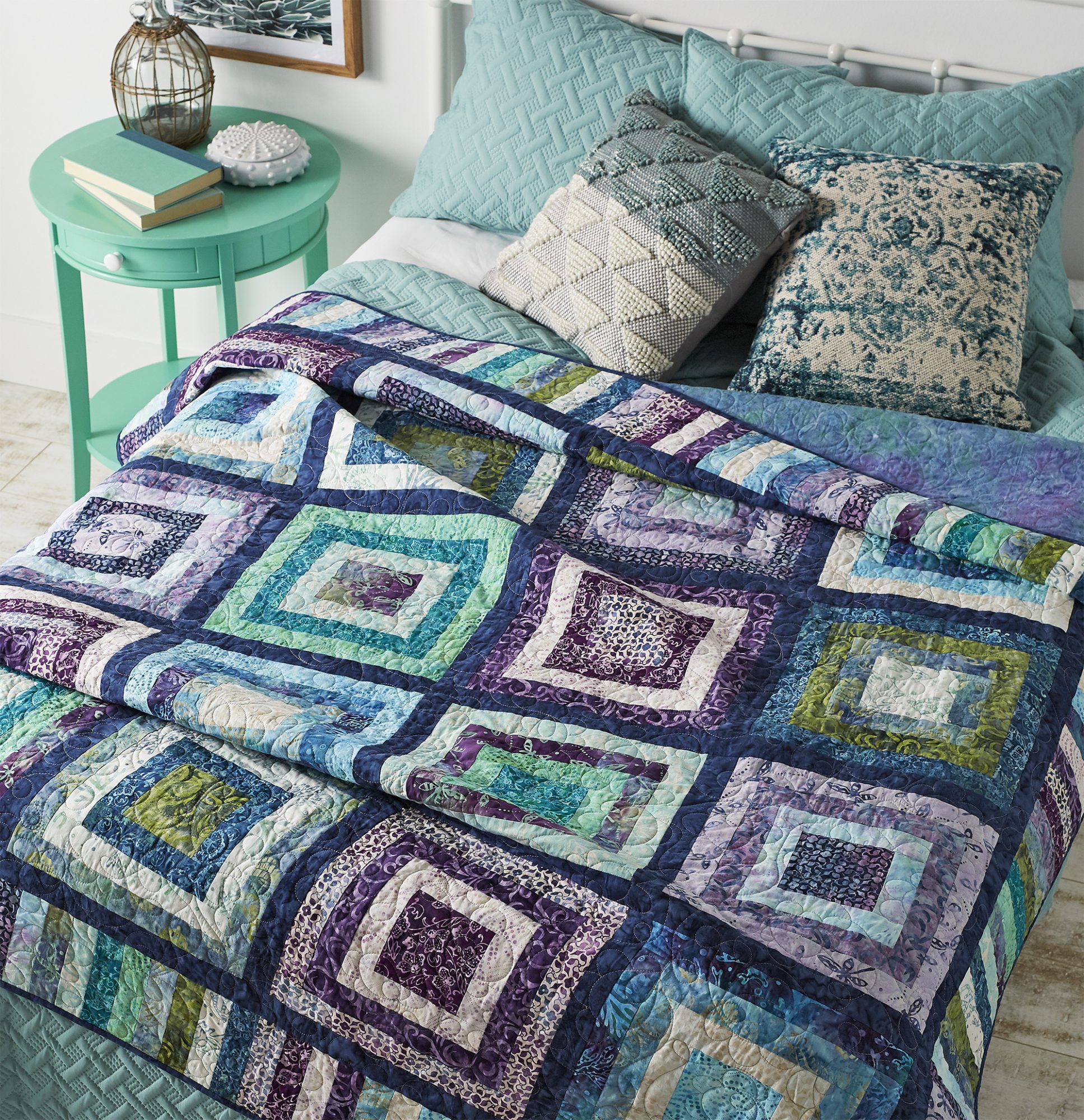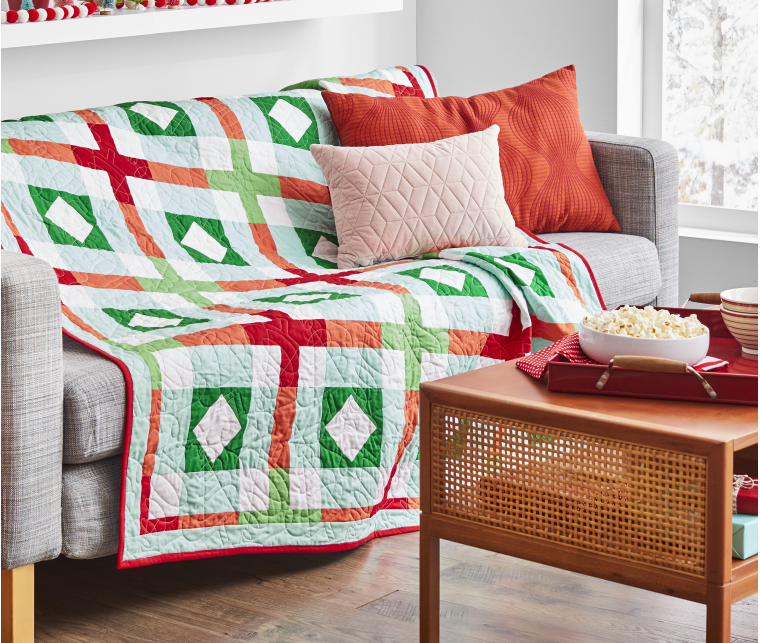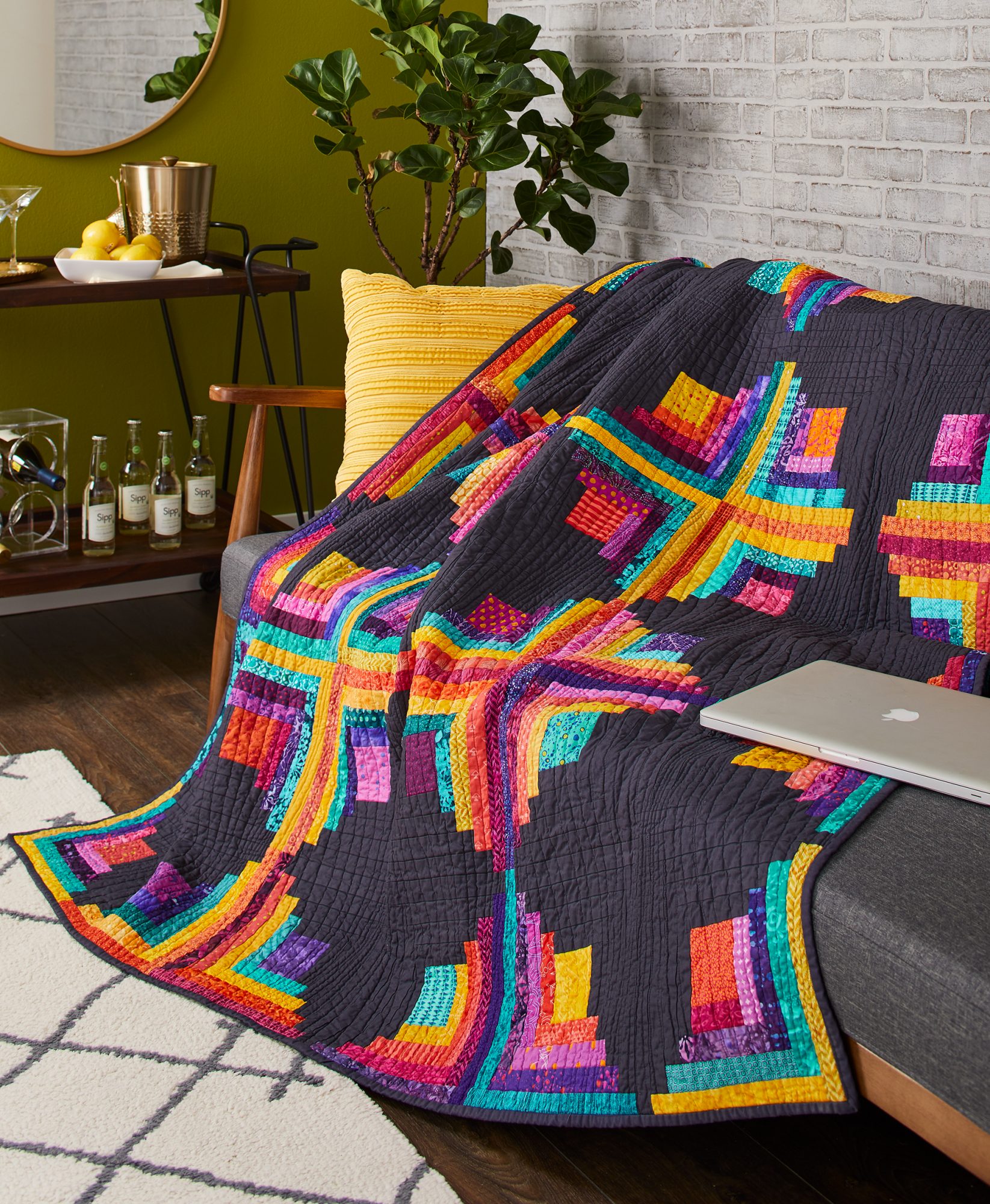
The French Twist Quilt Pattern brings together rich fabric colors, diagonal movement, and a woven basket effect. Against a soft cream background, the pieced motifs look almost like overlapping ribbons. Small colored squares in the sashing repeat the quilt’s warm palette and give the whole layout a balanced, inviting finish.
This is a lovely project for quilters who enjoy traditional prints but want something with a little movement. Burgundy, navy, olive, plum, antique gold, and rust work beautifully together, making the design a natural choice for a cozy bedroom or a favorite reading corner. You will find a downloadable illustrated PDF guide near the end of this article, before the conclusion.
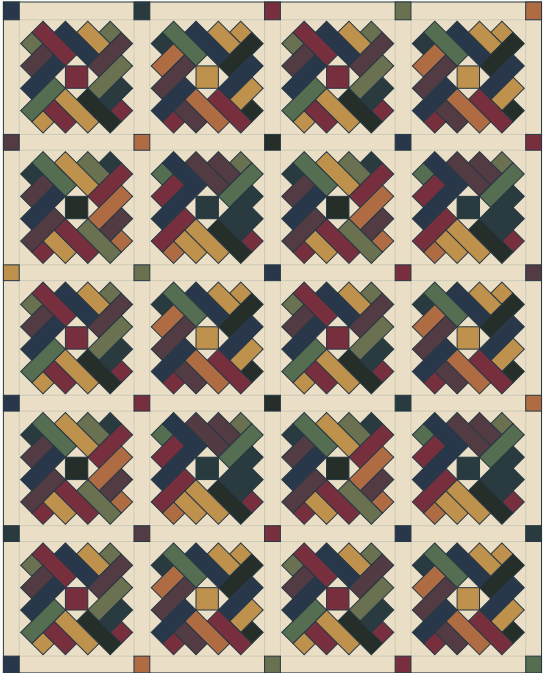
Much of this quilt’s charm comes from the way the strips appear to weave around a small center square. Each motif has four pieced arms, and turning the assembled block gives those straight strips their diagonal appearance. The light background keeps the individual fabric shapes easy to see, even when the prints are detailed.
The cream sashing also gives each block room to stand out. Instead of adding a large decorative border, the layout continues the same sashing and small cornerstones around the outside. This creates a consistent frame while keeping attention on the baskets.
Finished Size and Skill Level
The downloadable reconstruction is drafted for a planned finished size of 68 x 85 inches, approximately 173 x 216 cm, before quilting and laundering. It uses 20 blocks arranged in four columns and five rows. Each block finishes at 14 1/2 inches.
This project is best suited to intermediate quilters. The main techniques are accurate strip piecing, foundation piecing for the center, a partial seam to join the arms, and careful trimming after the block is turned. Making one complete test block will help you become familiar with the construction before preparing all 20 blocks.
Materials for the Illustrated Reconstruction
The following quantities match the accompanying PDF and assume 40 inches of usable fabric width where ordinary yardage is specified:
- Assorted prints: 20 fat quarters, each with at least 17 x 20 1/2 inches of usable fabric.
- Cream background: 6 1/2 yards, including a conservative allowance for cutting and a test block.
- Binding: 3/4 yard.
- Ordinary-width backing: 5 1/2 yards of a non-directional print.
- Wide backing alternative: 2 1/4 yards of 108-inch-wide fabric, instead of the ordinary-width backing.
- Batting: At least 76 x 93 inches, or the allowance requested by your quilter.
- Tools: Rotary cutter, mat, rulers, pins, iron, thread, and foundation paper. A square ruler at least 15 inches wide is useful for trimming.
Read the PDF before cutting, especially if your fabric has a narrower usable width or a directional print. The cutting chart separates arm pieces, center starters, background extensions, sashing, and cornerstones so that similar-looking pieces do not get mixed together.
Choosing Fabrics for a Beautiful Woven Effect
For a look close to the reference quilt, choose medium and dark prints with a traditional feel. Small florals, delicate vines, subtle dots, and restrained geometric prints provide variety without overpowering the piecing. The most useful contrast is between the cream background and the darker basket strips.
You can also give the French Twist Quilt Pattern a different mood. Navy and soft gray would create a quieter appearance, while red and cream could make a cheerful seasonal version. When changing the palette, keep enough contrast around the center and between neighboring strips to preserve the woven effect. Lay out a few fabric combinations before committing to all the blocks.
How the Quilt Blocks Come Together
1. Piece the Center
Each block begins with a center unit that measures 4 1/2 inches square before joining. The PDF includes a full-size foundation to establish the center’s geometry. Print that page at 100% or Actual Size, then measure the printed test line before sewing. Accurate printing is just as important as an accurate seam allowance here.
2. Build Four Arm Panels
The arms are made from rows of cream and colored pieces, followed by a long colored bar along one side. The row arrangement creates the stepped shape visible in the finished baskets. Each completed panel measures 10 1/2 x 6 1/2 inches before joining.
Keep the rows in their illustrated order and label the four panels for each block. This makes it easier to follow the color recipes and rotate the panels correctly around the center.
3. Join the Arms Around the Center
A partial seam connects the first panel to the center, allowing the remaining panels to be added in sequence. Once the other arms are attached, you return to complete the first seam. The illustrated guide shows this order so that the continuous strips can be preserved.
The assembled core should measure 16 1/2 inches square before the outer background pieces are added. Check this measurement before continuing; trimming later will not correct an incorrectly pieced core.
4. Turn and Trim the Block
Centered cream extensions provide fabric at the corners when the unit is turned 45 degrees. After turning, the small colored center square appears upright, and the basket strips run diagonally. Center the ruler carefully and trim the unit to 15 inches square unfinished.
Take your time with this step. An uneven trim can leave more background on one side and bring the basket points too close to the seam on the other. The PDF explains the positioning and shows the trimming outline.
Assemble, Quilt, and Finish
Arrange the blocks in five rows, using the alternating color layout in the PDF or a balanced arrangement of your own. Join them with cream sashing, then add the horizontal bands and colored cornerstones. In this reconstruction, the top and bottom bands are slightly wider than the interior bands to reach the planned 68 x 85-inch size.
A gentle overall quilting design can add texture without competing with the woven motifs. Diagonal lines can also echo the direction of the strips. Follow your batting manufacturer’s maximum quilting distance, and finish with a binding color that connects to one of the darker prints. Navy, burgundy, or charcoal would each frame this palette nicely.
Download the French Twist Quilt PDF Guide
The French Twist Quilt Pattern PDF guide includes a complete cutting chart, illustrated arm construction, the partial-seam sequence, a quilt layout, suggested color recipes, and a center foundation for printing at actual size.
The guide is an independently drafted reconstruction of the supplied quilt image, rather than the original commercial AQD307 pattern. Its geometry and cutting counts were checked mathematically; a sewn sample has not been tested. Make and measure one complete block before cutting the full quilt.
French Twist Quilt Pattern PDF Guide
The French Twist Quilt combines the comfort of traditional fabrics with an engaging woven layout. Its small centers, continuous strips, and orderly sashing give the quilt plenty of character. With careful measuring and the illustrated guide beside you, you can plan a version that reflects your own fabric collection and adds warmth to your home.